Showing posts with label Websites. Show all posts

Tuesday, April 30, 2013

Z is for Zummary


When it comes to genealogy research, there is no "Z".  Family History research never ends.  There is always someone else or something else to research.

In my final post in the A-Z challenge, I have 'cheated' with my final post, which is a zummary of my posts over the past month;

A - Ancestry.com (the highest number of views)
E - eBay - purchasing a memory (my second favourite post)
F - Family Search (my most used website for family history research)
J - Jargon
L - Letters
V - Victims of War (my personal favourite post)
Z - Zummary

Click for more posts

Saturday, April 27, 2013

eXchange rates and values


When researching Family History, it can be interesting to convert the currency of the past to current value.

In addition to understanding the history of the currency, it is also necessary to take into consideration inflation and exchange rates, if applicable.

Initial currency in Australia was varied with barter being being common.  Gold and rum were very popular forms of early currency.

After Federation in 1901, the federal government became responsible for currency.  When Australian currency was introduced in 1909 the Australian pound was specified as equivalent to 123.27447 grains of gold 11/12ths fine or 113.002 grains of fine gold.  The Australian Notes Act was passed in 1910 and the first set of Australian Notes was issued in 1913 and was based on the old British System.  Until 13 February 1966 Australian currency continued to be based on the British system, being one pound (£) divided into 20 shillings (s.) each of 12 pence (d.).

Until the depression in 1930, The value of an Australian pound was identical to the pound sterling. There was a gradual depreciation of the Australian pound in terms of sterling from the beginning of 1930 until December 1931 when it was stabilised at the rate of £125 Australian = £100 sterling.

Upon implementation of the conversion to Decimal currently on 14 February 1966, £1 Australian was set at $2.

In 1988, Australia began its conversion to plastic (polymer) notes.  By 1996, Australia became the first country in the world to have a full set of polymer bank notes.


Purchasing Power of 80 pounds in 1850
Source: National Archives Currency Converter
In 1847, my Great Great Grandfather, James Pilgrim, purchased a cottage in Upper Holt Street, Earls Colne for £80.  According to the National Archives Currency Converter this is equivalent to £4682.40 now.

However, when Inflation is taken into consideration, using the Bank of England Inflation Calculator, this increases to an approximate value in 2012 of £411,364.  According to Zoopla, the average house price for Upper Holt Street, Earls Colne is currently £390,359.


Receipt for 9 bags of almonds in 1964


In 1964, my Grand Uncle, Lloyd Pilgrim, received £68 4s 6d upon the sale of 9 bags of almonds.  According to the Reserve Bank of Australia Inflation Calculator, this is equivalent to $136.45 but when inflation is considered this increases to the equivalent of $1,707.10 today.

Friday, April 26, 2013

Wills & Probate Records

Wills & Probate records can be a great source of information for family history researchers.

We are very fortunate that Victorian Wills and Probate Records are available online at the Public Record Office Victoria.

My Great Grandmother told her family that her father's name was Richard Foy.  However, when we finally tracked down her birth record, there was no father listed.

Agnes Scott, Agnes Foy
Source: www.bdm.qld.gov.au

Therefore it was a source of relief to many family members to see Agnes listed as Richard Foy's daughter in his Probate Records.

Source: www.prov.vic.gov.au
The Probate Record also shows that Agnes and her sister May were using the Foy name (there is a mystery story here for another day) and they were living with their Grandfather, Samuel Drayton (and his address) at the time of Richard's death.

Now if only I could translate the Will for my 4 X Great Grandfather, Donald Scott, I may be able to obtain some more insights into the family.  This reminds me that you can search Wills on Scotlands People at no cost then pay a small fee to view the original record.

Click for more posts

Wednesday, April 24, 2013

UKBDM and Unlock the past

UKBMD provides links to websites that provide information on UK parish registers, births, deaths, marriages, censuses and other records. The links are easily located by county.

"All the Local BMD web sites are run by local volunteers from the various local family history societies.  Show you support for these groups by joining the local family history society for your area"

--------
Unlock the past  promotes Australian & New Zealand history, genealogy and heritage.  I recently attended the 3rd Unlock the Past History & Genealogy Cruise, which was terrific and resulted in many tips for additional research.
Amongst other things, the Unlock the past website lists upcoming Genealogy and Family History events in Australia and publish a range of easy to read genealogy guide books, which I have found very useful.

Click for more posts

Tuesday, April 23, 2013

Trove is Terrific

Trove is a terrific resource for more than just those researching Australian family history.  It really is a Treasure Trove for anyone who is interested in history or historical research.

So what is Trove?  Trove is a search engine managed by the National Library of Australia , which brings together collections of Historical Newspapers, Books, Pictures, Diaries, Letters, Maps and more.

The Newspapers are my favourite. I have been able to locate so much information about my ancestors by searching in Trove.

A search on my Great Great Grandfather "James Pilgrim Winiam" brings up 249 mentions of James in newspapers,including Awards, Weddings, Deaths, Community Service, Obituary, Farm Accidents, Meetings etc. Further results are revealed when the town (Winiam) is excluded or just the Surname, Pilgrim, is searched.

A search of "A-Z" revealed the following:

The Horsham Times
Friday 31 July 1931
Source: http://trove.nla.gov.au

"A Z" - HIS NAME
"What's your name?" asked a messenger
in the Criminal Court at Bridgeport (USA),
as a tall negro asked for his fee for giving
evidence in a criminal case.  "A Z" was the reply.  
"A Z what?" "A Z nothing, just A Z"
"Were you christened A Z?"
"Yes, I was the only child, and I guess they
gave me that name 'cause I was the
first and last"


The Brisbane Courier
Monday 17 July 1933
Source: http://trove.nla.gov.au

The Mercury (Tasmania)
Wednesday 20 May 1908
Source: http://trove.nla.gov.au

Click for more posts


Monday, April 22, 2013

Scotlands People


If you have Scottish ancestry, you must visit the Scotlands People website.

There is a charge for searching and obtaining most records on the website but personally I believe it is well worth it.

The website includes indexes and copies of documents showing, births, deaths, marriages, census records, valuation rolls, Wills and testaments. Unfortunately I cannot show you examples due to copyright laws.


My tips to obtain better results when you search:
  • Use "Wildcards allowed" when searching (use down arrow) or asterix
  • Start wide and then narrow your search
  • Many Scottish names were interchangeable (eg. Grizel & Grace, Donald & Daniel, Agnes & Nancy). Therefore searching by surname initially then narrowing your search result can be very beneficial.
  • You can search without inserting a surname
  • Don't include the sex in initial searches to broaden your results (it is not always recorded correctly)
  • You can search up to 5 parishes (or all) at one time.  If you know the general area where your family originated then also search the surrounding parishes as people did not typically travel very far in the past.  There are maps on the website to assist identify the neighbouring parishes.
  • Read the Help and Resources to obtain the most from the website.
  • The site records your prior searches but it is also possible to export your search results into an excel document.
  • Death records of females can be recorded under maiden name rather than married name

Unconfirmed Scott ancestors. You can read more about my research here.

Saturday, April 20, 2013

Ryerson Index and RootsWeb

Source: www.ryersonindex.org
The Ryerson Index lists death notices and obituaries in Australian Newspapers dating back to the 1800s. Searching the index is very easy.  The indexes are primarily from NSW newspapers but representation from other states is growing as more volunteers participate.  If your local paper is not included, think about volunteering to increase the records available for researchers.


Source: www.rootsweb.ancestry.com
RootsWeb is a free website that enables you to share your family tree, peruse submitted trees and connect to other people, who have similar research interests.

Users can submit information to the "User Contributed Database" to assist other researchers, such as the Dictionary of Genealogy & Archaic terms featured in a prior post.  

I have submitted the surname and details of my "brickwalls" to the relevant mailing lists and message boards hoping that I can connect to others who are researching the same people.  If your surname is not listed, you can create a mailing list.

Also check the Surname lists to connect with others who are researching the same families.

You can also build your own genealogy website with free webspace provided by RootsWeb.

Additionally, there are many volunteering opportunities available.

Click for more "R" posts

Thursday, April 18, 2013

Public Record Office Victoria

www.prov.vic.gov.au

The Public Record Office Victoria is the archives centre for the State Government of Victoria.  They "hold approximately 100 kms of records from the mid 1830s to today".

There are many records which have been digitised with more being added regularly (follow their blog for updates).

A visit to the archives centre is a must for anyone researching family history in Victoria.

The records that I use predominantly are

1.  Passenger Lists
  • Index to Unassisted Inward Passengers to Victoria 1852 - 1923
  • Index to Assisted British Immigrants to Victoria 1839 - 1871
2.  Wills and Probate Records for 1841-1925 are available online

Some of the other records held by the Public Records Office Victoria which may be of interest to family history researchers include:

  • Adoption and Wardship
  • Court Cases
  • Education & Teacher Records
  • Inquests
  • Mental Health Records
  • Parish & Township Plans
  • Prisoner and Convict Records


Click for more A-Z posts

Wednesday, April 17, 2013

Old Bailey Online

Old Baileys
Source: State Library of Victoria
Edward Oxford
At the Old Bailey
22nd June 1840

Did you have relatives who were criminals or may have testified against criminals?  
If so, you are likely to be able to find detailed records in the relevant archives.

Once such source is the Central Criminal Court of London and Wales, commonly known as the Old Bailey, after the street it stands on. 

The proceedings of over 197,000 trials between 1673 and 1913 are available online and make interesting reading.


Click to see more "O" Posts

Tuesday, April 16, 2013

National Library of Australia


www.nla.gov.au

The National Library of Australia offers some terrific resources for those researching their Australian family history.


One day (thinking I will need a week or more) I shall visit the library in Canberra but at present I use the eResources.  I'd suggest that you take the time to browse the Genealogy Category so that you are aware of the resources available.

Most Australian researchers would agree that the best resource within the National Library of Australia website is Trove.  It is an excellent source of information about our ancestors and times gone past (but you will need to wait until my "T" post to hear more).

An Australian resident can obtain a library card and then has access to a wider range of resources, such as 19th century UK newspapers.

Other "N" websites that I use for researching Australian Family History:
National Archives of Australia - this is covered more in my prior "Defense Records" post
news.google.com/newspapers - Historical newspapers from around the world.  It is more difficult to find things than in Trove but it is interesting to browse.

Click to see more N posts

Thursday, April 11, 2013

Jargon

Ahnentafel, Banns, Dropsy, Gedcom, Messuage and Tenement are all terms that most family history researchers are familiar with.  

How many of these Genealogical terms beginning with "J" do you know?
Jack
Jackson White
Jarl
Jiereschieve
Joined Stool
Jointure
Jongleur
Julian Calendar
Jund
Justicar

You can find the meanings in the Rootsweb Dictionary of Genealogy & Archaic Terms. 

Additionally, FamilySearch provides a comprehensive list of Latin Genealogical terms and words to assist with research.

Click to see more posts

Wednesday, April 10, 2013

Immigration Records

Did some of your ancestors seemingly just appear or swim to get to their destination?  Or have you been able to locate the boat they arrived on?

Most of my relatives arrived at Port Phillip (Melbourne, Victoria,Australia) and the records held by the Public Record Office Victoria (PROV) are very good.

My Tips:
  • Visit the Public Records Office to obtain a copy of the original records, which have more information than the online indexes (refer below for an example).
  • Search under similar or alternate spelling as the records are not always indexed correctly (eg I have found Gully recorded under Sully and Mottram under Mottrim)
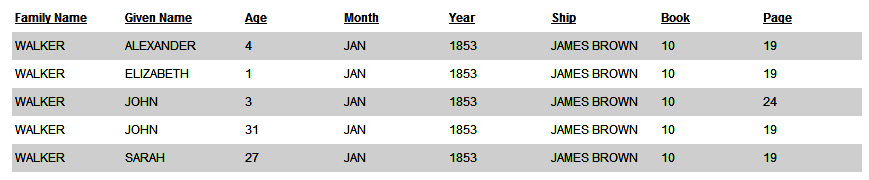
The search result below shows that my Great Great Great Grandparents John and Sarah Walker arrived on the James Brown in January 1853.  It also shows their ages.  You will note that John junior (aged 3) is listed on page 24, while his family are listed on page 19.  This is because he died on the journey.
Immigration Search Result
www.prov.vic.gov.au
The original record shows the following additional information;
  • Occupation - Agricultural Labourer
  • Native of Cumberland
  • Religion - Church of England
  • Both John and Sarah can read and write
  • John has 6 years employment with Mr Goldsmith of Trawalla, being paid £50 per annum
  • Their meals were provided on-board (as their passage was paid by the government)

Source: Public Record Office Victoria
Prior to 1852 (before Victoria became a colony) all immigration records are held by the NSW State Archives. 

There are many Australian immigration websites.  The following are the links that I have bookmarked:
Convict Records
Family History SA - South Australian Shipping & Migration Directory
Ozships
Perth Dead Person's Society - includes Western Australian (and other states) shipping records
Public Record Office Victoria - Assisted passenger index
Public Record Office Victoria - Unassisted passenger index
State Records of NSW Immigration Records
State Records of NSW Shipping List
State Library of Queensland lists the links for immigration records for every Australian State
State Library of South Australia Passenger Lists
State Library of South Australia Immigration Records

Please feel free to include additional immigration links in the comments.  I am very interested in any websites that list emigrants from UK to Australia.

Click to see more posts


Tuesday, April 9, 2013

Historical Societies

Historical Societies are a great source of information for family history researchers and often have additional information, which is not available over the internet.

Over the years, I have written to several Historical Societies to obtain information (as many do not have internet).  Every one of them has been most helpful and obliging.

The smaller historical societies are usually staffed by volunteers and require a donation to complete research.  I am always happy to provide a donation as I really appreciate their assistance and the work that they do. It is also a good idea to provide them with a copy of your research and contact details, to assist any other family members researching the same family.  One day I hope that a distant cousin will make contact with me and we can share research.

In particular, the Maryborough Historical Society has provided me with the most interesting and useful information, including details from local newspapers that have not yet been digitised.  This led to me to discover that a lamp that I had admired since I was a child, was a wedding present to my great grandparents from my great great grandfather! You can read more about this here.

The Maryborough Hospital Admission records also provided me some useful information and leads on many family members, who lived in the area.  It is the only record I have found which shows my Great Great Great Grandfather's arrival in Australia from America.

The record below told me Samuel's age (year of birth), occupation, residence, importantly the Port of Embarkation, the ship he arrived on (a whaling boat), how long he had been in the colony (when he arrived in Australia) and religion.  Fantastic information for a researcher who has hit a brick wall!

Sophia, Nantucket
Maryborough Hospital Admission Record
There are many Australian Historical Societies listed at Coraweb.  Ballarat Genealogy also lists more Historical Societies in Northern and Western Victoria.

My tip:  Write a letter to the historical societies in the districts where your family lived.  You never know what information that you shall find.

Click for more posts


Saturday, April 6, 2013

FamilySearch

FamilySearch is my NUMBER ONE website for family history research.

Having gathered records for over 100 years, they have the largest collection of family history records from around the world.  You can read more about the organisation by clicking here.

Additionally, all records are free and there are many images of records available too.

When you first open the web page www.familysearch.org you will immediately see the search screen;

Source: www.familysearch.org


It is very easy to find indexed records quickly by using this search screen.  However I urge everyone to take a tour of the entire website as there is so much more available.

The "Catalog" is very useful to let you know what is available. If you are unable to find a particular record, it may be because it is not available.

Source: www.familysearch.org


If you know dates, then you can also browse images.  Scroll to the bottom of the home page then select the country you are interested in;

Source: www.familysearch.org
When you see the small camera, it means that there are images available.  For example, if you have relatives who came from Cornwall, go into "United Kingdom and Ireland", then "England, Cornwall Parish Registers", then "Browse through 202,481 images".  Each of the towns will then be shown and you can browse parish registers.

Source: www.familysearch.org

When you have the date of baptism, marriage or death of your ancestor, it is always a good idea to find the original image as a couple of times I have found that the date has been indexed incorrectly.

Click on the Tree in the top left corner of  www.familysearch.org to take you back to the home page.
Don't forget to check out the free learning resources available. There is so much to choose from for all levels of researcher; from beginner to advanced.

Source: www.familysearch.org
It was recently announced that there will be improvements and changes to the site soon (including a new logo), which will make it even better.

My tip:  Make sure that you have a lot of time available as an hour can soon become two or three!

Click to see more posts


Thursday, April 4, 2013

Defense records (Australia)

There are a number of websites that provide valuable information if you have ancestors who served in the Australian Defense Force.

My first visit is always to the National Archives of Australia website, which provides a myriad of useful information.  The enlistment papers show the full name, service number, age, parent/s, place of birth, residence, religion, occupation and most importantly to me, a physical description and signature, which are often not available elsewhere.  You will also find service records, medical history, any medals received and sometimes a photo.

Read everything carefully as you never know what you will find.  The letter below led me on a new direction of research.  You will note that the letter is signed by Amy Richardson, giving permission for her son, Roy Weir, to enlist.

Amy Pilgrim, Amy Weir,
Source: www.naa.gov.au
Click to Enlarge

                                                                               
" Nhill
 9th July 1915

I Amy Richardson being the mother of Roy Weir do hereby consent to his volunteering for active service with the  Australian Imperial Forces.
Amy Richardson

I certify that my father is dead and that above is my mothers signature
Roy Weir"


It was this letter that led me to discover that Amy had married John Richardson after the death of her husband, James Weir.  In records in the following year, she was signing "Amy Weir" again.  Why?  It turned out that John Richardson was already married when he married Amy so the marriage was soon annulled!  I wouldn't have discovered this, except for the above letter.

The sister site, Mapping Our Anzacs, allows you to add photos and tributes to your ancestors, once you have created an account.

The Australian War Memorial website is also a great source of information; too much for me to mention here.  The search function is excellent but you really need to browse all the tabs and menus to get the most out of the website as there is so much available.

The letters below, which were located on the Australian War Memorial website, told me more about the death of my Great Grand Uncle, Henry "Harry" Mottram.

" He was a fine soldier and never knew what fear was"


Source: www.awm.gov.au
Click to enlarge

Source: www.awm.gov.au
Click to enlarge

The Commonwealth War Graves Commission website provides information on those who died in battle and where they are buried, including grave/memorial reference. There are also details and photos of the cemeteries and maps showing the layout, to make it easier should you plan to visit.  It also provides the ability to print a commemorative certificate for your records, which often includes the name of parents and residence.

Search result from www.cwgc.org
Click to enlarge

Source: www.cwgc.org

Certificates for World War 2 service can be printed at the World War 2 Nominal Roll website.

Click to enlarge
source: www.ww2roll.gov.au

ANZACS online is "an online military museum which displays photographs, diaries and letters, relating to the many Australians who served in the Australian Infantry Force during WWI".

I urge people to submit copies of their photos and memorabilia to ANZACS online so your ancestors can be remembered and to help other family members who may be researching them.

There are so many great websites for researching your ancestors who served in the Defense Force.  I have listed that sites the I have bookmarked.  Have fun and Happy hunting!

AIF Project - http://www.aif.adfa.edu.au:8888/index.html
ANZACS Online - http://anzacsonline.net.au/
Australian Government Military History - http://australia.gov.au/
Australian Institute of Aboriginal and Torres Strait Islander Studies http://www.aiatsis.gov.au/fhu/military.html
Australian War Graves - http://www.australianwargraves.org/home/w1/i2/
Australian War Memorial - http://www.awm.gov.au/
Commonwealth War Graves Commission - http://www.cwgc.org/
Defence Honours and Awards - http://www.defence.gov.au/MEDALS/
Department of Veteran Affairs - http://www.dva.gov.au/commems_oawg/nominal_rolls/Pages/index.aspx?
Don't forget the Diggers - http://www.dontforgetthediggers.com.au/photo_archive.asp
Flotilla Australia (war ships) - http://www.flotilla-australia.com/hmat2.htm
National Archives of Australia - http://www.naa.gov.au/
Mapping our ANZACS - http://mappingouranzacs.naa.gov.au
War Memorial records search - http://australia.gov.au/
World War 2 Nominal Roll - http://www.ww2roll.gov.au/

Click image for more posts

Wednesday, April 3, 2013

Cyndi's List


 www.cyndislist.com

When I first started researching many years ago, Cyndi's list was one of my most frequently visited websites.  If I wanted to know where to look for information, then her website would guide me in the right direction.

There are now over 320,000 genealogy related links on her website, which is free to use.  It is very important to spend time browsing the categories and to open every link in a new tab.
"I find that often people just automatically use the search engine on the site and don't explore the categories and sub-categories. I have had feedback from people telling me that they learn about new record types, new sources, and new ideas just by browsing." Cyndi Howells
Please click on the image to see more A-Z posts
My theme in the Blogging from A-Z April Challenge is my favourite websites for family history research.

Tuesday, April 2, 2013

Births, Deaths and Marriages

Ordering certificates when researching your family history can be very beneficial.  For me, the information is sufficiently rewarding and valuable to warrant the cost.

I didn't always feel this way, but for many years now I have incorporated certificate purchases into my monthly budget (yeh, I am an addict and would prefer to buy certificates rather than go out to dinner).

We are very fortunate in Australia as our certificates usually contain a lot of information that you cannot obtain elsewhere.

The birth certificate of my Great Great Grandmother, Charlotte Drayton, helped further my research in many ways.

Samuel Drayton Philadelphia
Click to enlarge
In addition to providing me with the exact date and place of birth, it gave me some very valuable research clues;
  • Middle name "Esther".  Children are often named after grandparents.  Research revealed that Esther was the name of Charlotte's grandmother.
  • Fathers age, occupation and place of birth. It was a surprise to see that Samuel Drayton was from America.  He is the only American ancestor in the family.  
  • Mothers age, place of birth and prior name. This led me to find records of Sarah arriving in Australia with her prior husband and children from her first marriage.
  • Sisters name and age
  • Year and place of marriage.  I couldn't locate the marriage until I obtained this certificate. The marriage was recorded under "Raiton" rather than "Drayton".  Neither Samuel or Sarah could sign (showing they were uneducated and likely poor) so it was probably written the way it was pronounced.
Don't forget to also check the names of witnesses as they often lived nearby or were family, which provides another direction for research.

However, don't believe everything that is on certificates, especially Death Certificates.  Quite often the family members reporting the death were mistaken and sometimes our ancestors didn't want people to know the truth!

I have bookmarked my favourite websites for researching Births, Deaths and Marriages;

FamilySearch free indexes - https://www.familysearch.org/

Australian State Registries - http://australia.gov.au/topics/law-and-justice/births-deaths-and-marriages-registries

www.ryersonindex.org (death notices and obituaries - primarily NSW)

South Australia
www.genealogysa.org.au
www.familyhistorysa.info/
http://www.jaunay.com/earlybdm.php

Victoria
http://www.rootsweb.ancestry.com/~ausvic/mwi.htm#W  (Marriage Witness Index)

United Kingdom
http://www.freebmd.org.uk/
https://www.gro.gov.uk/gro/content/certificates/default.asp
http://www.scotlandspeople.gov.uk/

Please let me know if you have any other websites that you can add.

Click on the Link to see more posts in the Blogging from A-Z April challenge

Monday, April 1, 2013

Ancestry.com


When researching your family tree, it is very important to have a suitable method to record and sort the information and photos that you obtain.

There are many programs and sites out there but I am most familiar with Ancestry and Family Tree Maker

My mothers ancestors (family tree) on ancestry.com

The Family Tree Maker program, which included a free trial to Ancestry.com, was initially a gift from my husband, who wanted to make things easier for me and reduce the amount of paper records that were lying around the house.  It worked!

Initially, I used the free subscription to get me started but did not initially renew when it expired.  I started my research on the cheap, using only free websites, but soon realised that paying for subscriptions and certificates reaped better and more comprehensive information.

Now I choose to use Family Tree Maker by Ancestry.  Not only because I am familiar with the program but because Ancestry is the world's leading provider of genealogy research and records. (Please note I am not affiliated with the company in any way).

PROS
  • Billions of records from around the world
  • Easy to use
  • Tutorials and research guides available
  • Ability to synchronise Internet Tree with Family Tree Maker 
  • Having an offsite back-up of research information and photos
  • Ability to connect to family members and those researching the same families
  • Provides regular hints, making it easy to find new information
  • Ability to have a "Public" and/or "Private" tree
CONS
  • Many family trees have wrong information as facts have not been verified.  Use trees as a guide but don't rely on the information.  Verify with certificates (my next post).

My Tip:  Just make a start! Talk to your family and obtain as much information about your family as you possibly can, then begin a family tree on ancestry.com.  Very quickly your tree will have grown many branches!


This is the first of my posts in the Blogging from A-Z Challenge.  Over the month of April, I will be making a daily post (except Sunday's) about my favourite websites for family history research. 

I would also like to thank Arlee for starting the Blogging from A - Z Challenge.

Click to see more posts