Showing posts with label Bound. Show all posts

Saturday, May 13, 2023

Hats in Time

Believed to be the wedding of Edith Bound and Eduard Geyer in 1886
 
In days of old, a hat did hold
A charm and grace, a tale untold.
Upon the head, it sat with pride,
A symbol of style, a dashing stride.

Eva Pilgrim (nee Blythman)

A gentleman's hat, so debonair,
Topped with feathers or ribbon fair.
A touch of class, a dash of flair,
A hat that spoke of savoir faire.

Bessie and Abel Bound with Mrs Excell and Ruby Bound
Estimated to be 1890

For ladies fair, a hat adorned,
With flowers, ribbons and lace adorned.
A fashion statement, a work of art,
A hat to captivate every heart.

Unknown Lady, Great Aunty Eve Walker and Great Aunty Madeline Walker

In times gone past, a hat was worn,
To shield from sun or bracing morn.
A protective shield, a shield of shade,
A hat to don on every escapade.

Great Grandparents Mary and Ambrose Walker with horses Buzz & Silver
We believe the child is Aunty Phyllis Walker - about 1930

Oh, hats of old, we long to see,
The elegance and grace you used to be.
Though fashion changes, trends may sway,
Your timeless charm will never fade away.

I love the way that my grandfather, Gordon Walker, is looking at my nanna, Rita
At the wedding of my Aunty & Uncle in 1965

So let us raise our hats up high,
To bygone days and days gone by.
For in those hats, a story told, 
Of fashion style, and stories old.

Caroline "Carrie" Warner


Saturday, January 29, 2022

Barn Yard Capers!

"I did not think you would get involved in this Barn Yard caper" 

I can still hear my grandmother's disgust when she made a surprise visit in 1989 and became aware that I was living with my boyfriend (who is now my husband of more than 30 years).

Gran was very proper and had a religious upbringing.  She did not believe in cohabitation. If only she had known!!

Gran had always told me that her grandparents were married on the 2nd Feb 1886.  Several family history books confirmed this.


I found it very curious when I ordered a marriage certificate and found that the actual date of marriage was 2nd February 1888, not 1886!
Edward Geyer and Edith Bound were married in February 1888

Their eldest child, my Great Grandmother, was born 20th April 1888, being two and a half months after her parents married.

Edward and Edith Geyer's eldest child was born in April 1888.

It seems that over several generations, my grandmother was the only one who was not "involved in the Barn Yard capers"
-------------------------------------------------------------------
This is the fourth post in the 52 ancestors in 52 weeks challenge
#52ancestorsin52weeks
This week's prompt is 'curious'

Thursday, January 13, 2022

A Favourite Find: The Pangs of Thirst

Last week I wrote about widow Jane Bound and her nine children's journey to Australia in 1878. Twenty-three years later, history was repeating.  Jane's daughter, Edith, was now also widowed like her mother had been, and was taking her children on another life-threatening journey, looking for a better life. It did not go to plan.

This is only part of Edith's story of adversity and courage.  More can can be read here.

Thirty years after the trip, this article was written by my Great Grand Uncle, Melville Geyer, who would have been near 7 years of age at the time of the journey.  He has changed the names but it is obvious that he is writing about his own family and memories, and it reinforces stories told by family members.

Source:  http://trove.nla.gov.au  (click here to view article)
The Horsham Times, Tuesday 1st September 1931, page 6


OVERLAND TO MILDURA
Waggon Trip from Nhill 30 Years Ago
THE PANGS OF THIRST. 
(By M. Geyer.)


The following is a description of a trip by waggon to Mildura from Nhill: It was in November, 1901, that Mrs. Smith (Edith Geyer), a widow with a young family of seven children - four boys and three girls - the eldest 13 (my Great Grandmother, Mabel) and the youngest two (Lily), decided to seek a living in Mildura, having heard that any child how ever small who could pick fruit off a tree, could earn 4/ or 5/ a day. 

Source: http://trove.nla.gov.au
Chronicle (Adelaide, SA : 1895 - 1954), Saturday 24 June 1899, page 26

Being in very poor circumstances she looked about for means of cheap transportation and heard of a Mr. Brown going to Mildura with his 5-horse team and waggon to look for work on the Mildura railway line. He agreed to take Mrs. Smith and family and her delicate brother (Abel Bound, who was later declared insane) up for the sum of £5. The route we were to travel was marked out for us by a friend, who had gone a few weeks previously. We left Nhill on (Saturday) November 16 and made for Jeparit, Lake Hindmarsh and Hopetoun. Then Mr. Brown decided to slip the line to Mildura instead of the other way. We crossed from Hopetoun to Minapin, now Lascelles, at that time a wine shanty and tents. A beautiful lot of pines grew where we camped overnight, but we did not have much sleep because of the noise of the drunks and the yelling of the woman who kept the shanty. 

We never took provisions or horse feed for long trips, as we were told there was plenty on the way we should have gone. We started up the line next morning; there was no road, just a stretch of white drift sand, and we toiled on all day, finding no water and having only our water bags full, which were soon empty.  We camped at Woomelang, where there were no houses, only another shanty and drunks. Mother went to the woman at the hotel to buy a drink of water for the baby, who was crying for a drink and she said, "No. I won't give you or sell you water. I pay to get it carted here. I'll sell you wine." But that was no good to baby. Next morning we moved on again,  but we were still without water and it was beginning to tell on the horses. 


Source: http://trove.nla.gov.au
The Argus (Melbourne, Vic. : 1848 - 1957), Thursday 5 December 1901, page 6

In the evening it was a joy to behold a large dam that had over flowed its banks. Just as we drew in and the men went to fill the water bags, 300 railway workers, with horses and drays, pulled in on the other side. They would not allow the men to fill the water-bags. Our driver and uncle told them they were going up the line to look for work, carting provisions from one camp to another or any other work they could find, but the men told them there was no room for them on the line. They told our driver there was a large tank about two and a half miles further on and grass up to the horses' knees. Mother and the children never showed themselves out of the waggon while at the dam. So off we went without water, expecting to find it at the next tank. Mother and uncle walked, one each side of the track so as not to miss the tank. The children by this time had cried themselves to sleep for the want of a drink. 

Although it was bright moonlight, there was no sign of any tank or water. Towards morning, however, a tank was sighted, and oh what a sigh of relief came from us. There was a wild rush to it, but what a disapointment when it was reached, for it only held about a cupful. The driver had first dip: then my uncle pushed him aside and dipped up what he could with a tea spoon and gave the children a few precious drops each; mother and he going without. (Perhaps it was just as well it was not full or we would have suffered from over drinking.) 

Then we pushed on again, travelling all day without water. Men may have their fancies for pets, but give me a dog, for men have not half the sense of a dog when it comes to finding water. Our dog, Bruce, used to jump up in the waggon and look up into our faces, as much as to say, "Please do give me a drink," but when he was told there was no water, he would just jump down. One evening he was missing from behind the waggon. We had just started off again in the morning, when he came and jumped into the waggon, the first time he ever did it while we were on the move. Uncle said, "Look out, he's gone mad." But he was sopping wet; he jumped down again, ran back to the edge of the scrub and started to bark. The men grabbed the water-bags and followed him. The dog led them to the tank we were looking for. Then we took the horses out and gave them a well-needed and earned drink and a bit of a feed. We boiled the billy and had a longed-for cup of tea, thanks to Bruce. Had it not been for the dog finding the water, we could not have lasted the day out, nor could have the horses. 


1901 Journey Route (approx 300kms over a week)
Less than 4 hours today.
Source:  Google maps

By this time we had reached the drift sand; the horses were knee deep in it. (Could this have been what is now known as Wyperfeld National Park, which is renowned for pines and sand drifts?)  The journey was telling on the horses, which were on short rations, as there was no place where we could buy feed of any sort for them. Our water-bag was the only thing we had to carry water in. Uncle by now could see how things were going, so he used to hide the bag and serve it out with a tablespoon. On we went, mother and uncle walking and keeping on the look-out for tanks; empty ones greeted us every 30 miles. I will never forget our approach to the Seven Sister Hills (the dread to motorists to-day). There was a fire raging on both sides of us; the heat and smoke were some thing unbearable. How those poor horses lived through it, God only knows. All the wild animals of the bush were fleeing along the track: dingoes, kangaroos, rabbits and even snakes going for their lives. 

Day was closing in on us, but still we toiled on. There was no water for the horses which were up to their girth in drift sand, swaying and moaning as they hauled their load, with their tongues hanging out; it was pitiful to hear them. Mother put the children to bed and continued to walk, although her feet were sore and blistered. As we were going over the third hill the waggon struck a root and all but capsized. Then the king bolt struck a stump and held fast. The driver wanted to hook the horses on behind the waggon and pull it back but mother and uncle hung on to the horses heads and would not allow him to move them another step that night. The animals were unyoked, and all the feed the five horses had that night was a small dish of chaff and 25 [lb] of flour. 

The men decided to walk on and see if there was any other track over the hills. Mother sat in the waggon ringing a bullock bell so as they would not wander away and get lost. Back they came towards morning. There was no other road. The men snatched a hasty meal and a few hours sleep. Then we were up at daylight, with hills in front of us and we stuck fast on a stump. The eldest boy (Arthur) had to crawl under and chop the stump off so as we could clear the axle of the waggon: this done, we tried cutting a fresh track around the hill, but this was impossible. There was only one thing left, go straight over the top. To do this everything had to be unloaded and carried up to the top of the sand-hill, then loaded in after the team reached the top. Then down to the bottom, unload again and carry up to the top: this was done till the hills were crossed. It was as much as the horses could do to pull the empty waggon over the sand-hills. 


An unlabelled photo from a family album is reminiscent of the Geyer's journey; the landscape, wagon,  billy and the dog.
The Geyer's dog, Bruce, located water and saved the family's life.
Edith and the children, hid in their wagon whenever they neared groups of men (primarily railway workers).

Up till now we had been following along the track where the railway line was going to be put through. Mother and uncle decided not to follow this track any further. We met a man on horseback and he said, "If you see the[last]sign of a track leading off this one, follow it, but if you miss it, goodnight, because you will die of thirst." Mother walked one side of the track and uncle on the other. Mother noticed the track (only just a faint wheel-mark) so she waved to uncle and he rushed over, grabbed the leaders' heads and turned the outfit into it. Once in there was no hope of getting out for it was impossible to turn the team in the dense scrub. The driver swore and cursed, and threatened not to move another step. Mother and Uncle hurried on, leaving the driver to have his swear out. 

On the way mother climbed a leaning tree and on looking out above the other trees she could see horses and the bank of a lake. She was so overcome with joy that she just slid down, lay on the ground and cried as if her heart would break. Uncle tried to comfort her, told her to try and keep up and not to give in just yet as we may find water any hour now. She couldn't speak, only pointed up the tree. He climbed up and saw the lake and ran back to the driver yelling, "Thank God we are saved. There is water ahead. We're saved. We're saved." We hurried on, or rather what we thought was hurrying, as the poor horses had no hurry left in them by now. We reached the lake. which we found was Lake Hattah. When we were nearing it we could see hundreds of men and horses camped on the bank. Our men took the water-bags to get them filled, mother and the kiddies hiding in the waggon. The men were met with the head ganger (and if this man is still alive to-day, or any of the other men that were there, they can bear me out as to the condition we and the horses were in). Mother's and uncle's tongues were swollen to the roof of their mouths. The ganger said the man who passed us before had called in and told him that we were on the way and that we should be at the lake about 10 o'clock in the morning. If we were not there by that time, we would have missed the turn off and perhaps be dead by night. The ganger had just formed a search party to go out for us. We reached the lake about 5 o'clock. The ganger ordered the men away with the command not to touch the water. It was agony to see the lake full of water and not allowed to have a drink. The ganger had ordered the cook to boil the billy and make us a drink of tea. We had to shift our camp about half a mile away from the water. Later he brought over the tea and only gave us each half a cupful and it was over an hour before we got another half cup: then another half hour and so on till we had quenched our thirst. 


Edith's "delicate brother"
Abel Bound, who was
instrumental in saving
 the family.
The horses were looked after by some of the other men of the camp. The poor beasts, they only got a quarter of a bucket of water at a time until their kidneys worked. The horses did not get any food for some time. Afterwards they received a well-earned feed of chaff, bran and oats. 

He told us to camp for the night, but uncle told him he would rather push ahead on account of his sister and the kiddies. The ganger said. "Leave that to me. You can sleep in safety." He sat on a stump with a loaded revolver and said he would shoot to kill if any man moved towards the waggon. He sat there all night and kept guard. He told us that had we missed the turn-off and if we could have lasted out, we would have had to go through to Mildura before we got water. 

 We were on the move again at sun rise and we will never forget the beautiful sight we saw. There were thousands of birds of all colors feeding on the seeds under the pine trees. We went from Lake Hattah across to Culcairn Station and camped for the night on the river bank. There was nearly a drowning fatality there. My young brother (Ernest) walked in for a paddle, and only took one step, when down he went into the river; the peg-mark showed 16 feet above summer level. My sister (believe this was Mabel as I seem to remember this story being told by my grandmother) had the presence of mind to lay on the bank and grab him by the hair and hold on till my uncle and the driver came over and pulled him out. 


Kulkyne Station c 1900
Source: http://museumvictoria.com.au/ 
Reg No: MM002690
I believe that Melville was referring to Kulkyne Station (written as Culcairn Station), near Hattah.

We called at the manager's house and inquired the way. He told us not to attempt to cross the billabong near the station, but to go two miles further down stream, as there was a safer crossing. He and his daughter had been into Mildura the week before and the water was running through the bottom of the gig. Our driver was pig headed: he would not go back. The manager told him to take out a horse and ride across and try the stream, but, no, he could drive over all right. 

Just before we came to the river, the whip came off; it was a God-send that it did. Uncle fixed the whip and got out on the shafts of the waggon to drive the leaders, so that the driver could keep the back pair up. In they went, with the water rushing over their backs. How those poor horses swam and pulled the load behind them will always remain a mystery. The water filled the waggon, everything getting sopping wet, also mother and us children. Uncle had his work cut out keeping the leaders going and balancing himself on the shafts. All you could see of the horses by the time we reached the middle of the stream were their heads. If anything had have happened we would have been all drowned in the swift-flowing stream. We got across safely and decided to camp there that day and dry our bedding, clothing, etc. as we could not make Mildura that day. When we came to have a look round, all our pots, pans, buckets and other things we had stored under the waggon were gone in the river. 


My Great Grandmother, Mabel Geyer (the eldest child of Edith Geyer), picking olives at Mildura
circa 1902 - aged 14 

We spent the day roaming round watching the goannas, and they were there by the hundreds in all sizes from infants in arms to ones up to six feet in length. We started out next morning (Sunday) for Mildura, the land where milk and honey were supposed to be flowing. We arrived there in the afternoon in time for tea. 

The heat and flies were something terrible all the way up; flies are bad in Egypt (Melville Geyer was in Egypt during WWI), but nothing like they were going up that track. When we left Nhill they told us that there were tanks every 30 miles apart; no doubt the tanks were there all right, but they were sunk down in the ground. The kangaroos, dingoes, rabbits and other animals, driven by the fire, plunged in to these and were drowned, so you can guess what the smell was like. 


We saw Mildura at its worst. First came the heat wave and scorched every thing; then the year following came the locust plague which stripped every thing. Things were bad and we were advised to leave, and we did. They told us Mildura was going broke, so we took the train back to Lascelles, then on by a covered van and three horses on a much better track. 

We have the pleasure of stating we were the first white family to travel over land from Nhill to Mildura.


They made it!
Edith Geyer with her children and first grandchild - 1911
Back: Arthur, Melville, Lloyd and Ernest
Front: Sophie, Edith Geyer (nee Bound), Lily and Mabel holding Eva Pilgrim (my grandmother)
It is more than 120 years since that remarkable journey. I am very thankful that my Great Grand Uncle,  Melville Geyer, returned from the war and told the story for future generations to applaud and recognise their struggle and courage.  I am in awe!
-----------------------------------------------------------------------------------------------------
This post was originally published 24th April 2014 but has been revisited as the second post of the 52 ancestors in 52 weeks challenge.  The article was located while researching the Geyer brothers for an Anzac day post.
#52ancestorsin52weeks
This weeks prompt is "Favorite Find" and what a find it was!

Tuesday, January 11, 2022

What if........................?

What if my Great Great Grandfather, Alexander Walker, had died on the ship, rather than his younger brother, John?

What if my Great Great Great Grandfather, Samuel Drayton, had stayed on the whaling boat and returned to America, rather than jumping off in Australia?

What if my Great Great Great Grandmother's first husband, Andrew Hayes, and their two children had lived?

What if any of my ancestors had chosen to go anywhere other than Australia?

I would not be here today!  Our ancestors are our foundations.

According to DNA testing, my origins like many Australians are primarily English, Irish and Scottish.


Although there is speculation (no evidence) that we have aboriginal ancestry, the first known ancestors to arrive in Australia were Samuel and Catherine Mottram, who arrived at Van Diemen's Land (Tasmania) on 8th August 1838 aboard the convict ship Lord Lyndoch. Samuel was a soldier and was accompanying 330 convicts from England to Australia.  The wives of 6 soldiers were also onboard.

1848 was the most popular year of immigration with 11 of my ancestors arriving in Australia.


Of the 36 direct line ancestors who made their way to Australia;

  • The majority were from England
  • There were 9 couples
  • 6 Children (youngest was 2 years old and the average age was 7)
  • 9 Singles (average age of 25), including a 23-year-old Irish lass
  • 2 Widowers (oldest was 64)
  • 1 Widow
Although there are many stories of hardship and challenges, there is one story that sticks in my mind.

Amelia 'Jane' Bound was 38 years old and pregnant with her 11th child when her husband died in Cornwall in 1877.

Jane had a brother in law, Thomas Bound at Macau Creek, near Riverton in South Australia, who had written glowing stories about Australia as a land of "Milk and Honey".  One of the recounted stories (tall tales) was that he could row a boat along the river and fill it with oranges from trees overhanging the bank. This convinced Jane that she should take her children to Australia.

'Tommie' became Jane’s Australian nominee, and whilst Jane’s age was beyond that acceptable for migration, the fact that her family contained six boys influenced the Queen to grant a special dispensation, which Jane applied to the authorities for, and the migration was allowed to proceed.

Jane Bound had one strong and abiding faith, namely that “The Lord will provide”.  When she was unable to muster sufficient financial resources to fund the migration project, there was a storm that blew down a huge oak tree in the house yard. Only when it was on the ground was its cash value realised.  The local timber merchant made oak chests out of a portion of it, in which the family belongings were packed, and the sale of the remainder allowed the migration to proceed. "The Lord will provide".

On 5th July 1878, being within 10 months of becoming widowed, Jane and her nine surviving children (aged 19, 16, 14, 12, 10, 7, 5, 2, and 7 months) having surmounted all obstacles were aboard the SS Oaklands which sailed out of Plymouth bound for Australia.

Their next hardship came when the Oaklands was becalmed for many days around the equator area.  Drinking water had to be rationed and the younger children nearly perished in the heat.

Also during the voyage, Jane had her purse containing all her worldly wealth stolen.  The Captain had a collection taken up which saved the day, so once again the Lord did provide.

 On September 22nd, 1878 the family arrived safely in Port Adelaide to begin their new lives in Australia. Seven Year Old, Edith Bound, would become a strong pioneering lady also and one day would be my Great Great Grandmother.

Information about Amelia Jane Bound was provided by her Grandson Frank Bound, primarily from family stories. Immigration records provide confirmation.

------------------------------------------------------------------------------------------------------------

This is the first instalment of the 52 ancestors in 52 weeks challenge. This week's prompt is "Foundations"

Saturday, April 23, 2016

Thomas Congdon Bound

Tom and Sarah Bound
From the album of Eva Scott (nee Pilgrim)
Tom Bound
From the album of Eva Scott (nee Pilgrim)


Thomas Congdon Bound was born on the 24th November 1867 at Hurlands, St Pinnock, Cornwall, England.  He is the sixth of the eleven children of William and Amelia Jane Bound (nee Congdon).

After the death of his father on the 19th September 1877, the family immigrated to Australia on the 21st September 1878.

Tom married Sarah Jane Sanders in 1915 and he died in Mildura on the 10th July 1947,

Genogram showing Thomas Bound's relationship to me
Tom is my 3X Great Uncle

Click for more A-Z Posts


Saturday, April 16, 2016

Nina Beryl Tucker

Nina Tucker (Centre) and her first cousins once removed
(Eva & Lloyd's mother is a cousin to Nina)
Have you ever wondered what "First Cousin Three Times Removed" means?

Nina Beryl Tucker is my cousin, three times removed.  To determine the relationship, we therefore need to step back three generations of cousins.  

My mother's cousins are my first cousins once removed 
     (My Great Grandmother is their Grandmother)
My grandmother's cousins are my first cousins twice removed
     (My Great Great Grandmother is their Grandmother)
My great grandmother's cousins are my first cousins three times removed
     (My Great Great Great Grandmother is their Grandmother)

22nd January 1921
Sophie Geyer, Nina Tucker, Vic Presser, Lil Geyer, Eva Pilgrim and possibly Albert Presser

Genogram showing the relationship between those in the photo
with Eva Pilgrim being my Grandmother
Nina Beryl Tucker was born at Nhill on 13th July 1907 and died 3rd July 1978 at Horsham.

Click for more A-Z Posts

Sunday, January 3, 2016

One of the first fruit exporters; Ernest Bound


Ern Bound
From Obituary
"He always rubbed his hand together and said 'What can I do for you?' but everyone said he meant 'What can I do you for?'"1

Whether my grandmother was correct in her memories or not,  Ernest Bound (known as Ern) was a very successful business man, who was also involved in many aspects of the community. He was one of the first Victorians to export fruit to Europe, United Kingdom and India.2  At one time, his business supplied practically all the stores in the Wimmera (a large geographical area in North West Victoria, Australia) and a portion of South Australia with sauce.3  This is even more impressive when you consider that Ern had only a few weeks of formal schooling. 4

Ernest Bound was only 6 years old when he arrived in South Australia in September 1878 with his recently widowed mother, Amelia "Jane" Bound, and eight of his siblings, who were aged  between 7 months and 20 years of age.5,6

Source: Robert Geyer
The family initially lived in South Australia. Ernest Bound moved to the Nhill in Victoria in 1883.  In 1896, Ern and his older brother Tom (Thomas Congdon Bound) purchased sandy desert scrub land at Winiam, which was 'proclaimed as forever uninhabitable'.  Additionally they were 'handicapped by lack of capital'.  Over a number of years, they cleared land and planted apple, pear, peach and plum trees in conjunction with a market garden.  While they waited for the trees to mature and bear sufficient fruit to provide an income, they harvested the market garden with primary crops being tomatoes, pumpkins and watermelons.  An abundance of tomatoes resulted in the commencement of the Lowan Sauce Factory in 1909. 3,7,8,9

Trove; The Nhill Free Press (Vic.: 1914 -1918)
Friday 5 April 1918, Page 3
In 1910, they commenced using pruning and spraying processes as set out by the Victorian Agricultural Department, which increased yields.  They were soon exporting apples with contracts for 1300 cases of apples to Glasgow, Antwerp and Bombay in 1914.  The apples from the Bound orchard realised the highest prices in Europe so were favoured by the Melbourne exporters, which resulted in Ern exporting many apples directly to increase his profits. However the exporting was soon suspended with the commencement of World War 1. 2,7,13

According to a number of various newspaper reports, Ern was also very active in the community, being a member (and later chairman) of the Winiam Methodist Sunday School, secretary and member of the Winiam Rifle Club, Chairman of the Arbour Day committee, secretary and financial contributor of the "Telephone party" to bring telephone lines to Winiam, chairman of the School committee, member of the Cemetery Trust, member of the wartime Patriotic Committee, a Justice of the Peace and was nominated (but declined) a position as Councillor to represent the district.

Ern was fortunate to have a natural spring on his property, which was appropriately called 'Springvale'.  In 1915 a well was completed at a depth of 45ft where most wells in the area were 150ft.  He was rarely beaten and won many awards at the local shows for his tomatoes and during the war years he also had ewes and lambs, which flourished on being fed watermelons. 12,13

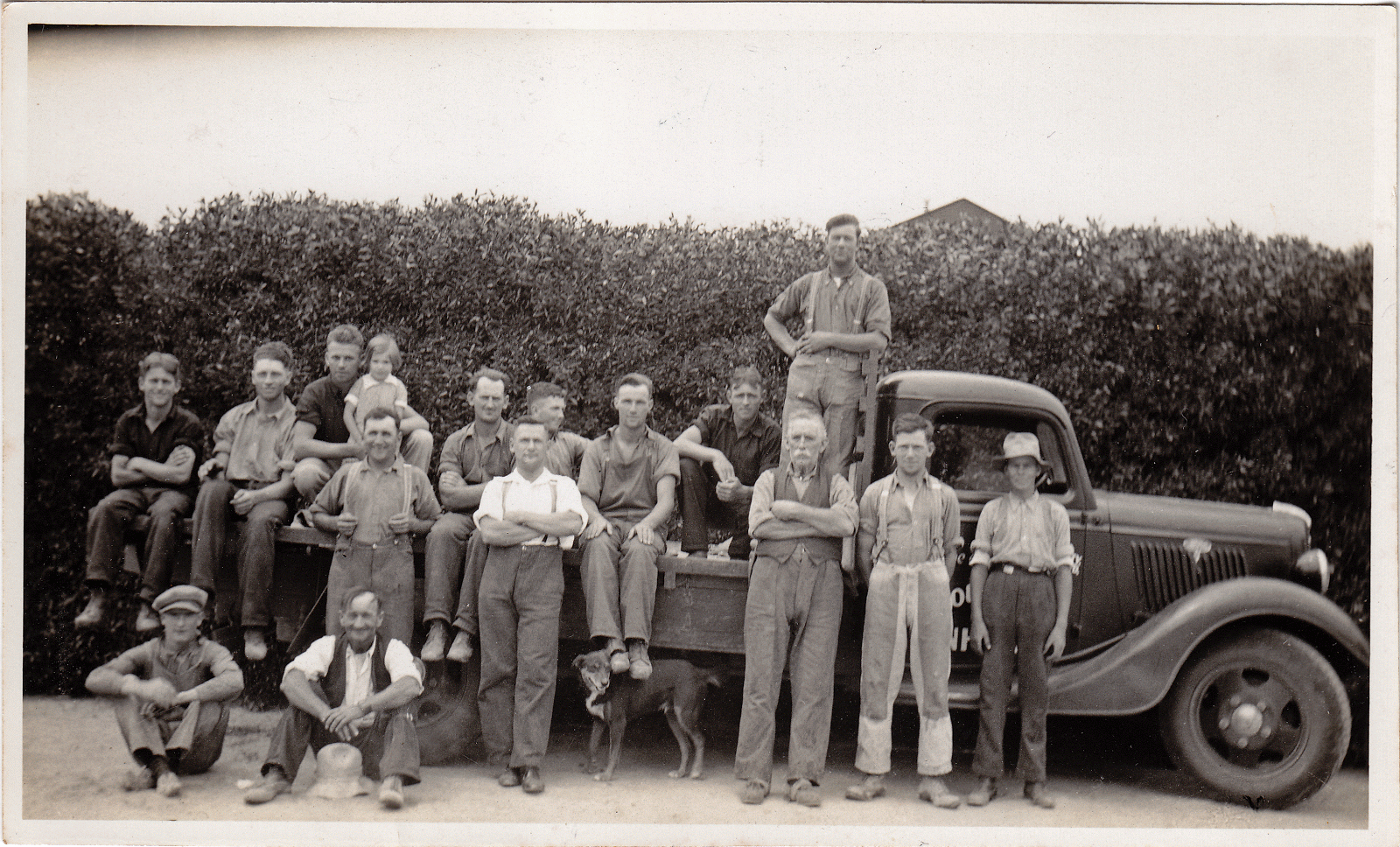
Circa 1935 - Bound Fruit Pickers.
Please let me know if you can identify any of the men.
Click to view a larger image.
With a surplus of fruit and tomatoes of reputable quality in the district and greater profit margins being achieved on retail sales, Ern decided to expand the business and in 1918 purchased a fruit and confectionery business in Nhill, which became known as the The Fruit Palace.  At this time there were 24 acres of orchards and 10 acres of market gardens.  The businesses continued to expand and flourish as a family affair with his four sons soon working with him in the company E Bound & Sons Pty Ltd, Lowan Preserving Works and Springvale Tomato Sauce. The businesses provided significant employment to the area and grew to 70 acres of orchards and market garden with 7000 fruit trees. 3,7, 14
Bound Fruit Pickers - Perhaps Ern standing in centre with white shirt
Please let me know if you can identify the men
Click for a larger image.
In 1934 they exported 2500 cases of apples and employed 15 men and utilised modern methods and machinery in the packing sheds.15

A letter from England in 1935 stated "I have received the case of apples so kindly sent by you and wish to express our admiration for the excellent manner in which they were packed, and the prime condition they were in.  Not an apple showed the least sign of decay and all were as sound as a bell.  One would have thought they had just been harvested the previous day from a local orchard.  As to their quality, I must say they are excellent; several of our neighbors sampled them, the unanimous opinion of all being that they are as good as the best apples they have ever eaten and better than most" 15

Circa 1935 - Bound Fruit Pickers
The sauce factory was sold in 1939. In 1947 they produced 25,000 gallons of fruit ice cream. 7

Ernest Bound died in Nhill on the 26th March 1953 when he was age 80.  The company E Bound and Sons Pty Ltd was disolved and the businesses split between his four sons. 4,7, 17

Ern Bound and family at Nhill - about 1932
Back, Tom Bound (with moustache) Frank, Ern, wife Emma, Ruby, Norm (holding Doris), Jeanette
Centre: Frank, Walter and wife Jean;
Front: Norm's children Betty and Muriel

This post was inspired by Sepia Saturday
Please click to read more posts

Sources;
1 Eva Scott wrote this in her notebook about her Uncle Ernest Bound
2 Trove: Western Mail (Perth, WA: 1885-1954, Farm & Station Notes, Friday 17 April 1914, page 3
3 Trove: Nhill Free Press (Vic.: 1914 - 1918), Tuesday 5th March 1918, page 2
4 Robert Geyer: first families 2001
5 State Records of South Australia
6 Trove: The South Australian Advertiser (Adelaide, SA: 1858-1889), Monday 23 September 1878, page 6
7 Obituary
8 Trove: The Register (Adelaide, SA: 1901-1929), Wednesday 15 June 1910, page 9
9 Trove: The Horsham Times, Tuesday 27 October 1925, page 2
10Trove: Nhill Free Press (Vic.: 1914 - 1918), Tuesday 12 May 1914, page 2.
12Trove:  Nhill Free Press (Vic.:1914 - 1918), Friday 21 May 1915, page 3
13Trove: Nhill Free Press (Vic.:1914-1918), Friday 3 March 1916, page 2
14Trove: The Horsham Times (Vic,: 1882 - 1954), Tuesday 27 October 1925, page 2
15Trove: The Horsham Times (Vic.:1882-1954), Friday 9 March 1934, page 6
16.Trove: The Horsham Times (Vic.: 1882-1954) Tuesday 4 June 1935, page 4
17 Australian Death Index


Friday, April 25, 2014

ANZAC Day Blog Challenge 2014: Introduction - A Mother's Love

Nothing compares to a mother's love. 

Can you imagine the prospect of losing your children?  Not once, not twice, but three times?

My Great Grandmother, Edith Geyer, was a very strong lady with great intestinal fortitude!

Edith Geyer during better times
Horsham c 1924

One month after the death of her husband to typhoid fever in May 1899, Edith (who was pregnant) was faced with the prospect of the family being torn apart as she did not have the means to support them.  However, with great strength of character and the aid of the local community of Nhill, she was able to keep the family together.  You can read more about Edith here.

Source: trove.nla.gov.au
The Horsham Times, Tuesday 13th June 1899, page 3
In 1901 , "being in poor circumstances", Edith decided to move the family to Mildura, "having heard that any child however small who could pick fruit off a tree, could earn 4/ or 5/ a day".  We cannot imagine the voyage.  The family were only hours from perishing. You can read about their amazing journey and tale of survival  here.  Did you notice that history was repeating itself?  In more ways than one!

Times were improving - Edith Geyer, her children and first grandchild
1911
Back: Arthur, Melville, Lloyd and Ernest
Front: Sophie, Edith Geyer (nee Bound)  Lil and  Mabel holding Eva Pilgrim

Then as things had started to improve and life was looking up for Edith and her family, World War 1 threatened to break her family apart again.  Her three youngest boys Lloyd, Melville and Ernest would all fight on the Western Front in France and Belgium.

We cannot begin to imagine how Edith must have felt.  She had no control.  She had struggled through adversity since she was born.  She had nearly lost her children twice before.  Through her perseverance and hard work, times were improving.  But would her world be ripped apart?

You can read more about Edith's three ANZACs by clicking on each of their names;
 Lloyd Morris Geyer
Melville Geyer
Ernest Theodore Geyer

You can read more Anzac Day Blogs here

Thursday, April 24, 2014

A family's remarkable journey overland from Nhill to Mildura in 1901

The amazing story below was found while I was scouring through newspapers on Trove, researching the Geyer brothers (my Great Grand Uncles) for an Anzac Day blog.  The character recognition listed the author as M. Ocyer rather than M. Geyer, which is why it had not been discovered previously.  You can imagine my reaction when I started to read it, as I immediately recognised it as the story of my Great Great Grandmother, Edith Geyer, and her children.  This is only part of Edith's story of adversity and courage, which can be read here.

The article was written by my Great Grand Uncle, Melville Geyer, who would have been 6 (closer to 7) years of age at the time of the journey.

Source:  http://trove.nla.gov.au  (click here to view article)
The Horsham Times, Tuesday 1st September 1931, page 6


OVERLAND TO MILDURA
Waggon Trip from Nhill 30 Years Ago
THE PANGS OF THIRST. 
(By M. Geyer.)


The following is a description of a trip by waggon to Mildura from Nhill: It was in November, 1901, that Mrs. Smith (Edith Geyer), a widow with a young family of seven children - four boys and three girls - the eldest 13 (my Great Grandmother, Mabel) and the youngest two (Lily), decided to seek a living in Mildura, having heard that any child how ever small who could pick fruit off a tree, could earn 4/ or 5/ a day. 

Source: http://trove.nla.gov.au
Chronicle (Adelaide, SA : 1895 - 1954), Saturday 24 June 1899, page 26

Being in very poor circumstances she looked about for means of cheap transportation and heard of a Mr. Brown going to Mildura with his 5-horse team and waggon to look for work on the Mildura railway line. He agreed to take Mrs. Smith and family and her delicate brother (Abel Bound, who was later declared insane) up for the sum of £5. The route we were to travel was marked out for us by a friend, who had gone a few weeks previously. We left Nhill on (Saturday) November 16 and made for Jeparit, Lake Hindmarsh and Hopetoun. Then Mr. Brown decided to slip the line to Mildura instead of the other way. We crossed from Hopetoun to Minapin, now Lascelles, at that time a wine shanty and tents. A beautiful lot of pines grew where we camped overnight, but we did not have much sleep because of the noise of the drunks and the yelling of the woman who kept the shanty. 

We never took provisions or horse feed for long trips, as we were told there was plenty on the way we should have gone. We started up the line next morning; there was no road, just a stretch of white drift sand, and we toiled on all day, finding no water and having only our water bags full, which were soon empty.  We camped at Woomelang, where there were no houses, only another shanty and drunks. Mother went to the woman at the hotel to buy a drink of water for the baby, who was crying for a drink and she said, "No. I won't give you or sell you water. I pay to get it carted here. I'll sell you wine." But that was no good to baby. Next morning we moved on again,  but we were still without water and it was beginning to tell on the horses. 


Source: http://trove.nla.gov.au
The Argus (Melbourne, Vic. : 1848 - 1957), Thursday 5 December 1901, page 6

In the evening it was a joy to behold a large dam that had over flowed its banks. Just as we drew in and the men went to fill the water bags, 300 railway workers, with horses and drays, pulled in on the other side. They would not allow the men to fill the water-bags. Our driver and uncle told them they were going up the line to look for work, carting provisions from one camp to another or any other work they could find, but the men told them there was no room for them on the line. They told our driver there was a large tank about two and a half miles further on and grass up to the horses' knees. Mother and the children never showed themselves out of the waggon while at the dam. So off we went without water, expecting to find it at the next tank. Mother and uncle walked, one each side of the track so as not to miss the tank. The children by this time had cried themselves to sleep for the want of a drink. 

Although it was bright moonlight, there was no sign of any tank or water. Towards morning, however, a tank was sighted, and oh what a sigh of relief came from us. There was a wild rush to it, but what a disapointment when it was reached, for it only held about a cupful. The driver had first dip: then my uncle pushed him aside and dipped up what he could with a tea spoon and gave the children a few precious drops each; mother and he going without. (Perhaps it was just as well it was not full or we would have suffered from over drinking.) 

Then we pushed on again, travelling all day without water. Men may have their fancies for pets, but give me a dog, for men have not half the sense of a dog when it comes to finding water. Our dog, Bruce, used to jump up in the waggon and look up into our faces, as much as to say, "Please do give me a drink," but when he was told there was no water, he would just jump down. One evening he was missing from behind the waggon. We had just started off again in the morning, when he came and jumped into the waggon, the first time he ever did it while we were on the move. Uncle said, "Look out, he's gone mad." But he was sopping wet; he jumped down again, ran back to the edge of the scrub and started to bark. The men grabbed the water-bags and followed him. The dog led them to the tank we were looking for. Then we took the horses out and gave them a well-needed and earned drink and a bit of a feed. We boiled the billy and had a longed-for cup of tea, thanks to Bruce. Had it not been for the dog finding the water, we could not have lasted the day out, nor could have the horses. 


1901 Journey Route (approx 300kms over a week)
Less than 4 hours today.
Source:  Google maps

By this time we had reached the drift sand; the horses were knee deep in it. (Could this have been what is now known as Wyperfeld National Park, which is renowned for pines and sand drifts?)  The journey was telling on the horses, which were on short rations, as there was no place where we could buy feed of any sort for them. Our water-bag was the only thing we had to carry water in. Uncle by now could see how things were going, so he used to hide the bag and serve it out with a tablespoon. On we went, mother and uncle walking and keeping on the look-out for tanks; empty ones greeted us every 30 miles. I will never forget our approach to the Seven Sister Hills (the dread to motorists to-day). There was a fire raging on both sides of us; the heat and smoke were some thing unbearable. However those poor horses lived through it, God only knows. All the wild animals of the bush were fleeing along the track: dingoes, kangaroos, rabbits and even snakes going for their lives. 

Day was closing in on us, but still we toiled on. There was no water for the horses which were up to their girth in drift sand, swaying and moaning as they hauled their load, with their tongues hanging out; it was pitiful to hear them. Mother put the children to bed and continued to walk, although her feet were sore and blistered. As we were going over the third hill the waggon struck a root and all but capsized. Then the king bolt struck a stump and held fast. The driver wanted to hook the horses on behind the waggon and pull it back but mother and uncle hung on to the horses heads and would not allow him to move them another step that night. The animals were unyoked, and all the feed the five horses had that night was a small dish of chaff and 25 [lb] of flour. 

The men decided to walk on and see if there was any other track over the hills. Mother sat in the waggon ringing a bullock bell so as they would not wander away and get lost. Back they came towards morning. There was no other road. The men snatched a hasty meal and a few hours sleep. Then we were up at daylight. with hills in front of us and we stuck fast on a stump. The eldest boy (Arthur) had to crawl under and chop the stump off so as we could clear the axle of the waggon: this done, we tried cutting a fresh track around the hill, but this was impossible. There was only one thing left, go straight over the top. To do this everything had to be unloaded and carried up to the top of the sand-hill, then loaded in after the team reached the top. Then down to the bottom, unload again and carry up to the top: this was done till the hills were crossed. It was as much as the horses could do to pull the empty waggon over the sand-hills. 


An unlabelled photo from a family album is reminiscent of the Geyer's journey; the landscape, wagon,  billy and  the dog.
The Geyer's dog, Bruce, located water and saved the family's life.
Edith and the children, hid in their wagon whenever they neared groups of men (primarily railway workers).

Up till now we had been following along the track where the railway line was going to be put through. Mother and uncle decided not to follow this track any further. We met a man on horseback and he said, "If you see the[last]sign of a track leading off this one, follow it, but if you miss it, goodnight, because you will die of thirst." Mother walked one side of the track and uncle on the other. Mother noticed the track (only just a faint wheel-mark) so she waved to uncle and he rushed over, grabbed the leaders' heads and turned the outfit into it. Once in there was no hope of getting out for it was impossible to turn the team in the dense scrub. The driver swore and cursed, and threatened not to move another step. Mother and Uncle hurried on, leaving the driver to have his swear out. 

On the way mother climbed a leaning tree and on looking out above the other trees she could see horses and the bank of a lake. She was so overcome with joy that she just slid down, lay on the ground and cried as if her heart would break. Uncle tried to comfort her, told her to try and keep up and not to give in just yet as we may find water any hour now. She couldn't speak, only pointed up the tree. He climbed up and saw the lake and ran back to the driver yelling, "Thank God we are saved. There is water ahead. We're saved. We're saved." We hurried on, or rather what we thought was hurrying, as the poor horses had no hurry left in them by now. We reached the lake. which we found was Lake Hattah. When we were nearing it we could see hundreds of men and horses camped on the bank. Our men took the water-bags to get them filled, mother and the kiddies hiding in the waggon. The men were met with the head ganger (and if this man is still alive to-day, or any of the other men that were there, they can bear me out as to the condition we and the horses were in). Mother's and uncle's tongues were swollen to the roof of their mouths. The ganger said the man who passed us before had called in and told him that we were on the way and that we should be at the lake about 10 o'clock in the morning. If we were not there by that time, we would have missed the turn off and perhaps be dead by night. The ganger had just formed a search party to go out for us. We reached the lake about 5 o'clock. The ganger ordered the men away with the command not to touch the water. It was agony to see the lake full of water and not allowed to have a drink. The ganger had ordered the cook to boil the billy and make us a drink of tea. We had to shift our camp about half a mile away from the water. Later he brought over the tea and only gave us each half a cupful and it was over an hour before we got another half cup: then another half hour and so on till we had quenched our thirst. 


Edith's "delicate brother"
Abel Bound, who was
instrumental in saving
 the family.
The horses were looked after by some of the other men of the camp. The poor beasts, they only got a quarter of a bucket of water at a time until their kidneys worked. The horses did not get any food for some time. Afterwards they received a well-earned feed of chaff, bran and oats. 

He told us to camp for the night, but uncle told him he would rather push ahead on account of his sister and the kiddies. The ganger said. "Leave that to me. You can sleep in safety." He sat on a stump with a loaded revolver and said he would shoot to kill if any man moved towards the waggon. He sat there all night and kept guard. He told us that had we missed the turn-off and if we could have lasted out, we would have had to go through to Mildura before we got water. 

 We were on the move again at sun rise and we will never forget the beautiful sight we saw. There were thousands of birds of all colors feeding on the seeds under the pine trees. We went from Lake Hattah across to Culcairn Station and camped for the night on the river bank. There was nearly a drowning fatality there. My young brother (Ernest) walked in for a paddle, and only took one step, when down he went into the river; the peg-mark showed 16 feet above summer level. My sister (believe this was Mabel as I seem to remember this story being told by my grandmother) had the presence of mind to lay on the bank and grab him by the hair and hold on till my uncle and the driver came over and pulled him out. 


Kulkyne Station c 1900
Source: http://museumvictoria.com.au/ 
Reg No: MM002690
I believe that Melville was referring to Kulkyne Station (written as Culcairn Station), near Hattah.

We called at the manager's house and inquired the way. He told us not to attempt to cross the billabong near the station, but to go two miles further down stream, as there was a safer crossing. He and his daughter had been into Mildura the week before and the water was running through the bottom of the gig. Our driver was pig headed: he would not go back. The manager told him to take out a horse and ride across and try the stream, but, no, he could drive over all right. 

Just before we came to the river, the whip came off; it was a God-send that it did. Uncle fixed the whip and got out on the shafts of the waggon to drive the leaders, so that the driver could keep the back pair up. In they went, with the water rushing over their backs. How those poor horses swam and pulled the load behind them will always remain a mystery. The water filled the waggon, everything getting sopping wet, also mother and us children. Uncle had his work cut out keeping the leaders going and balancing himself on the shafts. All you could see of the horses by the time we reached the middle of the stream were their heads. If anything had have happened we would have been all drowned in the swift-flowing stream. We got across safely and decided to camp there that day and dry our bedding, clothing, etc. as we could not make Mildura that day. When we came to have a look round, all our pots, pans, buckets and other things we had stored under the waggon were gone in the river. 


My Great Grandmother, Mabel Geyer (the eldest child of Edith Geyer), picking olives at Mildura
circa 1902-1903 - aged 14 or 15

We spent the day roaming round watching the goannas, and they were there by the hundreds in all sizes from infants in arms to ones up to six feet in length. We started out next morning (Sunday) for Mildura, the land where milk and honey were supposed to be flowing. We arrived there in the afternoon in time for tea. 

The heat and flies were something terrible all the way up; flies are bad in Egypt, but nothing like they were going up that track. When we left Nhill they told us that there were tanks every 30 miles apart; no doubt the tanks were there all right, but they were sunk down in the ground. The kangaroos, dingoes, rabbits and other animals, driven by the fire, plunged in to these and were drowned, so you can guess what the smell was like. 

We saw Mildura at its worst. First came the heat wave and scorched every thing; then the year following came the locust plague which stripped every thing. Things were bad and we were advised to leave, and we did. They told us Mildura was going broke, so we took the train back to Lascelles, then on by a covered van and three horses on a much better track. 

We have the pleasure of stating we were the first white family to travel over land from Nhill to Mildura.


They made it!
Edith Geyer with her children and first grandchild - 1911
Back: Arthur, Melville, Lloyd and Ernest
Front: Sophie, Edith Geyer (nee Bound), Lily and Mabel holding Eva Pilgrim (my grandmother)
It is more than 100 years since that remarkable journey. I am very thankful that my Great Grand Uncle,  Melville Geyer, returned from the war and told the story for future generations to applaude and recognise their struggle and courage.  I am in awe!

You can read more about Edith and her ANZACs by clicking on their names;