Showing posts with label Nhill. Show all posts

Saturday, November 14, 2015

Did Sir Charles Kingsford Smith inspire my grandmother to travel?

What will historians be saying about us in 100 years time?  

Growing up. I always considered my grandmother to be very old fashioned.  She was a very strong lady, who was very matter of fact.

She NEVER struck me as an adventurer!  But now I wonder?

Lloyd, Hazel, Lorna & Eva Pilgrim
on Trix 1924
"I boarded with Aunty Alice while going to High School and had visions of being a teacher, but Mum was going through change of life and when she went down with measles, I had to go home at 14.  I only had 6 years of schooling, as we lived over 3 mls from the school.  At first we had to walk.  They kept me home till I was 8 and John was 6.  Then he [dad] bought a pony for us and we got boils in summer from horse sweat, as we rode bareback........While at High, I always went home for wk ends and often got a ride back with the minister on Sun.  If not I rode Trix in Monday morning – 10 miles.  Tied the reins up and let her go.  Once she didn’t arrive home so Dad went looking for her.  She had pulled in to a farmers stable.  It was a paddock away from his house and only worked there some times.  There was a dam, green feed and some chaff in the mangers.  This old Trix was cunning and would come up with the horses Sat and Sun but not wk days.  When we had holidays, it would put her out.  I had to go and catch her as my brother could not.  I think he was cunning too.  He had a horse later – Kit.  Dad would drive Kit and Tammy in the buggy and the fruit van (before he got a motor vehicle) and they were a flighty pair.   In the van, we all sat on a board across the width of it and no back.  It used to take us over an hour to trot into Nhill – 10 miles – with a load and under the hour to go home.  The horses were always in a hurry to get home.  I love horses and working dogs, but not lap dogs." Eva Scott (nee Pilgrim)


Imagine if you can..............You live on a farm with your family and the main form of transport is horse and buggy, which you take into town (Nhill) every Friday to do the shopping.  How would you feel seeing your first aeroplane?   Would you be excited at the new technology and the possibilities?  Or would you be worried about the safety? Would you have had the courage to go for a flight?  


Source: http://nla.gov.au/nla.news-article203366719
The Age (Melbourne, Vic.:1854-1954),
Thursday 16 November 1933,page 10

8th November 1933 - Nhill
Southern Cross
From the album of Eva Scott (nee Pilgrim)

8th November 1933 - Nhill 
Southern Cross
From the album of Eva Scott (nee Pilgrim)

8th November 1933 - Nhill
Percival Gull Speed Plane
From the album of Eva Scott (nee Pilgrim)

 Nhill 1933
Gran's first plan ride (in the centre with white collar and cuffs wearing pilots hat) -  cost was 7/6 for 10 minutes

She rode a horse to school and needed to stay with her Aunty as the High School was too far from home (10 miles) and then 44 years later as a pensioner, she was able to fly to the other side of the world!

Imagine how Gran felt over 44 years later when she boarded an aeroplane bound for UK and Europe?

Click for more posts

Tuesday, November 11, 2014

Winiam State School Roll of Honour


Can you imagine how it must feel to have sons fighting in a war on the other side of the world?  Or the feeling of relief  and happiness when the war finished and your son would be returning home soon?  Or how about the feeling of sadness that your son would not be coming home, but feeling proud of his courage?

I cannot even begin to imagine.


About a week after the official end of World War 1, the following appeared in the Nhill Free Press on 19th November 1918;

"In accordance with the declaration by His Excellency the Governor (Sir Arthur Stanley) Sunday was observed in the local Methodist Church as a day of thanksgiving for the victory that has [crowned] Allied arms in the war, and a day of remembrance of those who gave their lives in the great cause of righteousness, justice, truth and freedom.

Mr W Barber officiated at the morning service, and Rev. W.M. Cannam in the evening.  The sacred edifice was crowded in the evening, and a large assemblage of country members and adherents was in evidence.  The honor roll, on which are the names of our gallant heroes, was entwined with the Union Jack, and there was an excellent display of red, white, and blue in the front portion of the church.  Thanks was offered to God for His Majesty the King and his statesmen, together with Kings and Presidents of Allied nations; for our gallant dead; for our doctors, nurses, chaplains, and other workers; prayers for the enemy.

Source: www. trove.nla.gov.au
Nhill Free Press (Vic.:1914-1918)
Friday 3rd May - page 3
The names of our fallen heroes which appear on the Methodist honor roll in this circuit were then read, and are as follows:- Privates A.R. and L. Anderson*, C Day, A.H. Dean,
H. Hales, H. Muller, T Stevens, F Argall, C.C. Collins, L Parker, E Taylor, - Baker, T. Dickinson, A. Munro, A.G. Warner*, G.J. Blythman, J.W Gniel*, A.J. and F.W. Weir*, Lance-Corporal F.E. Clark, and Sargeant L.J.G. Clark, after which the Dead March was played, the congregation standing with bowed heads.  Miss Davis officiated at the organ."1


Many of the above boys (marked *) also attended Winiam State School, who remembered the valiant efforts of their prior students by unveiling a Roll of Honour on Anzac Day (25th April) 1918.


Several of the young men listed are related to me.  All of them would have been well known to family members in the small farming community of Winiam.

I have previously paid tribute to the following relatives listed on the Honour Roll;

As we commemorate 100 years since Australia's involvement in World War 1 , please join me in the following weeks and months when I shall remember each of those listed on the Winiam State School Roll of Honour.

"They shall not grow old, as we that are left grow old
Age shall not weary them, nor the years condemn
At the going down of the sun and in the morning
We will remember them"

Lest We Forget


Sources
1 Trove - Nhill Free Press, Tuesday 19 November 1918, page 3


Side note: This post was written in advance and scheduled for automatic uploading @ 11am on Remembrance Day, 11th November 2014.  We will be on a cruise (refer prior post) and will be in Turkey on Remembrance Day but will still stop for a minute of silence to remember those who lost their lives and fought for their country.

Friday, October 17, 2014

A farmer and barber

My grandmother wrote about her cousin "Roy was the barber at Winiam.  He cut everyone’s hair – male and female.  He only shaved when he went anywhere.  The rest of the time he ran the clippers over his face".

I assume that it was Roy who cut my grandmothers plaits off, which I wrote about here previously.


My grandmother's cousins: Roy Pilgrim and Ray Muller
October 1929

Ararat Chronicle
Friday 14 January 1916 - page 2
Source:  www.trove.nla.gov.au

Roy, like most of the men in his family, was a very successful farmer.

Roy's son told me proudly that his father was a life member of Davey's barber shop and never had to pay for a hair cut.

Friday was the day that everyone from Winiam went in town - Nhill - and when Mr Davey's son Max was away as a RAAF (Royal Australian Air Force) pilot in the war, Roy helped out by cutting hair, which enabled Mr Davey to keep the business going until Max returned.  Roy's reward was the life membership and free haircuts.

Mr Davey's Barbers must have been  a long term institution in Nhill.  I found a newspaper article  that shows that the Barbers shop was destroyed by a large fire in 1916.  

However the Barbers shop must have been rebuilt as I found on the National Archives of Australia website that son Max was a fighter pilot in World War II from 1943 - 1946.  However the enlistment papers show his occupation as a Bank Clerk rather than Barber.


This post was inspired by Sepia Saturday.  Please click for more posts.


Sunday, June 15, 2014

Nhill Railway Station; A dangerous place?

This post was prompted by Sepia Saturday


 July 1886
"For two hours and a half the engine rattles over what have hitherto been such undisturbed, unfruitful solitudes that kangaroo have not yet learned to be frightened of any intruder, and sit placidly near the line while the train rushes by"1
"Nhill, 24 miles from Dimboola, is the largest township on the line between Dimboola and Adelaide.  It has the appearance of a thriving place, and there are large stacks of wheat on the platform ready to be sent down the lines"1
Nhill Railway Station with wheat waiting to be transported - Undated
From My Grand Aunts Album
 The Argus newspaper reports on the 15th July 1886 that the railway from Melbourne to Adelaide was not formally open but "passengers have been carried over the line since the 1st of this month"1


Nhill is a small country town in Western Victoria.  It is situated about half 
way between Melbourne and Adelaide and lies about 45 minute drive from
 the South Australian Border

Catastrophe was narrowly avoided the following month, in August 1886, when children of a farmer residing near the Nhill Railway Station, laid two wooden rails across the tracks, which resulted in a trolley of workmen being derailed. "One man had his collar-bone broken, and the others received injuries which necessitated medical attendance"......"The train from South Australian to Dimboola was due shortly after, and had the trolley not passed over the obstruction serious loss of life might have resulted"2

The opening of the railway must have been favourable to the farming community of Nhill as only a year later, in August 1887,  it was reported "The township is improving fast.  A large goods-shed and platform are being erected at the railway-station by Messrs. Sutcliffe and Harley to cost £837. A new post-office, telegraph station, and public offices are being erected by Mr. Irvine.  A new schoolhouse will also be erected, and the size of the hospital will be doubled.  It has also been decided to erect a shire hall at a cost of £800.  All these works will be proceeding during the next four months"3

Another train derailment was reported in the area in 1887, when "six trucks and the van ran off the line, tearing up several lengths of the rails and doing considerable damage to the tracks and van.  The cause of the accident is supposed to be the gradual sinking of the line in consequence of the wet weather and the heavy traffic passing over it."3 


Source:  http://trove.nla.gov.au/ 
The Argus (Melbourne, VIc: 1848-1957)
Wednesday 28 August 1889, page 8
Retrieved 13th June 2014


August Hirst (age 35) was the first recorded death at the Nhill Railway Station on 27th August 1889.  His "right foot was cut off just above the ankle, the left foot was crushed, and the skull was injured.  The body had been carried along the line for about 40 yards"

Shortly after, a poor horse "was cut to pieces"


Source:  http://trove.nla.gov.au
Chronicle (Adelaide, SA: 1895-1954)
Saturday 18 March 1899, page 21


My grandmother's journal reports another death relating to the Nhill railway station, although not directly;
"My grandfather was chief mechanic at the Nhill Railway Station.  He was sick in bed and something went wrong.  They sent for him.  Grandmother didn't want him to go. He did - got pneumonia and died"
My research has revealed that my Great Great Grandfather, Edward "Ted" Geyer, died 5th May 1899 from Typhoid (not pneumonia as my grandmother believed).

Melbourne Exhibition Building on ANA (Australian Native's Association) Day 26th January 1898
Source: National Library of Australia (Trove)
State Library of Australia Image Number H96. 160/565
On what is now known as Australia Day,  January 26th 1905, an excursion train ran to the ANA Fete (Australian Native's Association Fete) in Melbourne.  The second class fare from nearby Horsham to Melbourne was 18 shillings with first class fares nearly 50 percent more.4
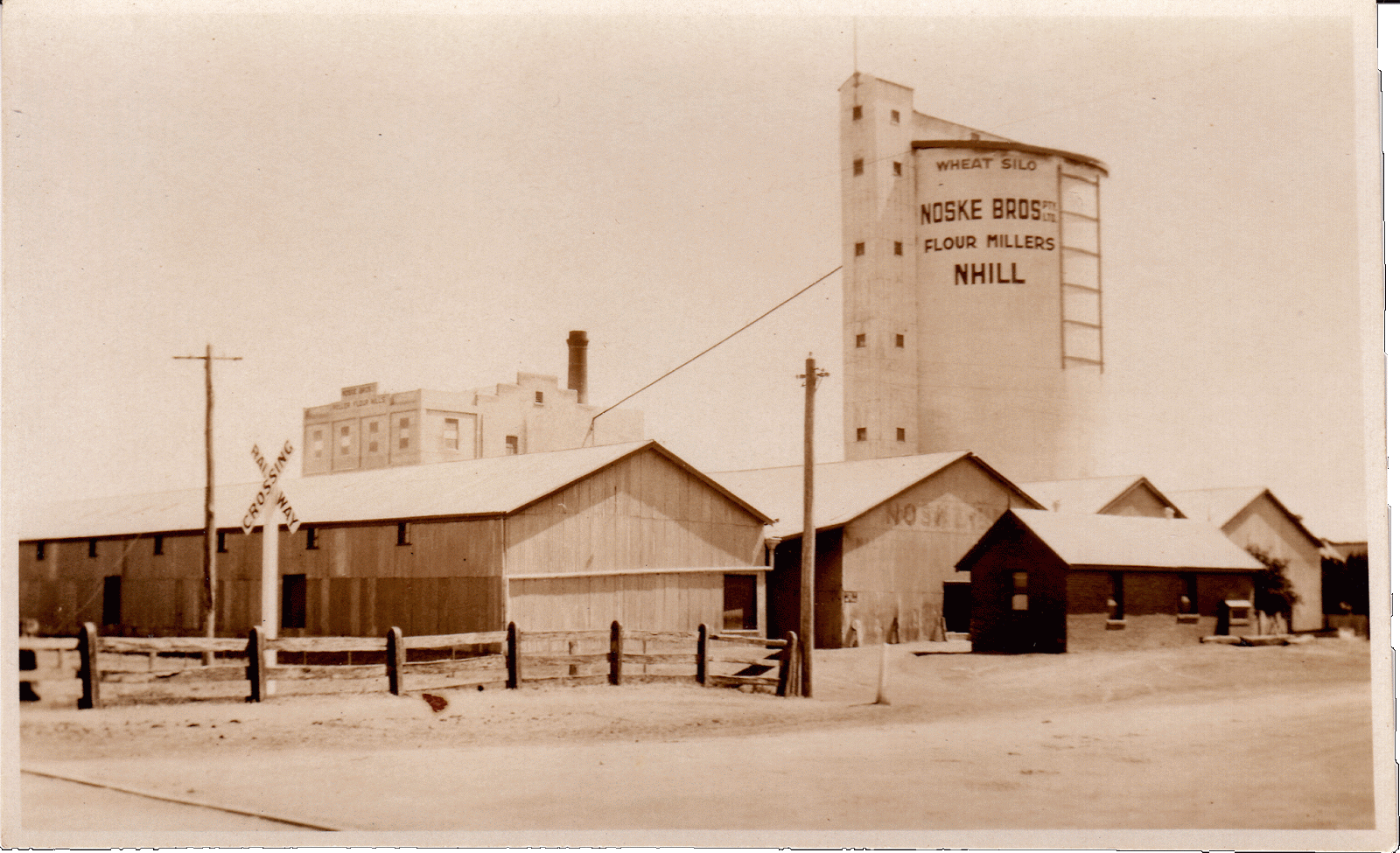
Railway Crossing at Noske Bros Flour Millers Nhill - Undated
From my Grand Aunts Album

In March 1905 another "accident occurred at the Nhill railway station at noon on Monday, resulting in the engine, tender, and two trucks belonging to the 1pm goods special leaving the rails and tearing up the permanent way for a distance of 20 or 30 yards.  It appears that the engine had shunted on to the siding leading to the Wimmera Flour Mill, where it picked up two empty trucks, and was returning to the main line when it suddenly left the rails, ploughing through the sleepers and the permanent way, as likewise did the tender and trucks.  Apparently the points were the cause of the mishap"5


In December 1905, Mr Strass was very lucky to be alive to celebrate Christmas;
"Almost stupefied by fright, he leaped forward over the dashboard.  The engine caught the buggy just in the centre and smashed it into a thousand pieces............by the aid of lanterns Mr. Strass was found, and fortunately he was not much hurt, although unconscious.  He was taken to Nhill and after a considerable time consciousness returned".6


The death of Mr Edwin Thurston, in 1906, made headlines around the country, including in Western Australia.

The Argus (Melbourne, Vic: 1848-1957), Friday 25 May 1906, page 4

Mr Edwin Thurston
Killed in a Railway Accident at Nhill on
May 24 1906
Source:  http://trove.nla.gov.au/ 
The Australasian (Melbourne),
Saturday  June 2 1906,  page 28
Retrieved 13th June 2014
"CAB RUN DOWN AT A CROSSING
NHILL, Thursday -  A Terrible railway accident occurred at half-past 1 o'clock this morning at the local railway station, when the the Melbourne express train, in shunting, dashed into a cab at the town level crossing.  At the time the train was backing to allow the Adelaide express in.  The cab-driver was hurled clear of the rails, but a passenger, Mr. Edwin Thurston, a commercial traveller for Patterson, Laing, and Bruce Limited, Flinders-lane, had not possible chance of escape.  The train forced the cab, with its hapless freight before it, for over 130 yards.  The guard tried to signal the driver, but failed, and the train was shunted the full distance.  Mr. Thurston, who was dead when picked up, had both legs almost amputated, several ribs fractured, and sustained abrasions on the head.  Dr Bennett says that death was probably instantaneous.
Anderson, the cab-driver, sustained concussion of the brain, and is now lying in the Nhill Hospital in a very low state.
When the express van struck the cab it cut the pole and trace in two, and the horses dashed off untouched.  The scene of the accident was visited by numbers of people today.  The cabman was endeavouring to take Mr. Thurston to the hotel, and to return to the station in time to attend the other express train.  General sorrow at the occurrence was expressed locally, as the deceased gentleman was highly esteemed here."7

A later report stated "William Anderson the man in charge of the cab, is an elderly man, who has resided in Nhill for many years and that one so well acquainted with the train movements should have fallen into such a grevious error of judgement, is inexplicable.  We learn that poor Anderson has paid for his rashness with his life, having died in the hospital."8

It was some years until I found record of another accident;

Source: http://trove.nla.gov.au/
Albury Banner and Wodonga Express
(NSW: 1896 - 1938), Friday 28 1919
page 29
31 March 1912 - Alfred R G Starick was killed when he accidentally fell between the cars when  changing compartments 9

25 Aug 1914 - A Guard, Peter Bannon, received a severe knock to the head during shunting, which resulted in unconsciousness and concussion of the brain.10


5 July 1916 - Another Guard, Mr Louis Bence, had his arm severely crushed between the buffers of two trucks 11

5 October 1916 - Horses bolted towards a train, they swerved at the last minute, overturning the buggy and throwing out the driver.  There were no serious injuries.12

27 November 1918 - A young soldier, Carl Kalleske, was returning from training in Melbourne.  As the train was coming into the station he opened the wrong door, overbalanced, falling off the train.  He was dragged along for several metres, with his arm was almost severed near the shoulder and later amputated.14

 28 February 1919 - George Cummings, a chauffeur was terribly injured when a train hit his car.  He later died in hospital. 15

12 January 1922 - Lieutenant Eileen Evans, of the Salvation Army, was on the platform at Nhill Railway Station with colleagues when the train began to move. The group was running alongside the train, scrambling to get back on.  At the end of the platform, Miss Evans fell. "The poor girl had one leg completely severed and the other was frightfully crushed" 16  She was operated on at the Nhill hospital but died from shock and loss of blood. 17


Source: http://trove.nla.gov.au/ 
Chronicle (Adelaide SA: 1895 - 1954) Saturday 15 November 1924, page 38

"DERAILED ENGINE HOLDS UP INTERSTATE TRAINS
Through the rails spreading near Nhill, in Victoria, early on Saturday morning, an engine and trucks became derailed.  The Adelaide express from Melbourne, the Melbourne express from Adelaide, and the East-West special to Melbourne were in consequence held up for some hours, and the passengers only got through by exchanging trains after much inconvenience. Left- The derailed engine Right - The Adelaide express held up near the signal, which stands at danger"

Nhill Railway Station from the Silo
Taken by my Grandmother, Eva Scott (nee Pilgrim) 1930

Sources (all retrieved from http://trove.nla.gov.au on 13th June 2014)
1 The Argus (Melbourne, Vic.: 1848 - 1957), Thursday 15 July 1886, page 10
2 The Argus (Melbourne, Vic.: 1848 - 1957), Wednesday 18 August 1886, page 6
3 South Australian Weekly Chronicle (Adelaide, SA 1881-1889), Saturday 3 September 1887, page 21 
4 The Horsham Times (Vic: 1882-1954), Friday 13 January 1905, page 2 
5 The Horsham Times (Vic: 1882-1954), Friday 31 March 1905, page 2
6 The Advertiser (Adelaide, SA: 1889-1931), Thursday 28 December 1905, page 7
7 The Argus (Melbourne, Vic: 1848-1957), Friday 25 May 1906, page 4
8 The Horsham TImes (Vic: 1882-1954), Tuesday 29 May 1906, page 4
9 The Register (Adelaide SA: 1901 - 1929), Monday 1 April 1912, page 6
10 Nhill Free Press (Vic: 1914-1918), Tuesday 25 August 1914, page 2
11 The Register (Adelaide SA: 1901 - 1929), Wednesday 5 July 1916, page 6
12 The Ballarat Courier (Vic: 1914-1918), Thursday 5 October 1916, page 5
14 Nhill Free Press (Vic: 1914-1918), Friday 29 November 1918, page 2
15 Albury Banner and Wodonga Express, (NSW: 1896 - 1938), Friday 28 1919, page 29
16 The Advertiser, Friday 13 January 1922, page 7
17 Daily Herald (Adelaide, SA: 1910- 1924), Saturday 14 January 1922, page 6


Click to see more Sepia Saturday Posts